No Products in the Cart


Last Updated: October 25, 2026
Quick Summary
American mahjong rules require you to build a hand printed on an annual card, while Hong Kong style lets you assemble any standard four-melds-plus-a-pair pattern and score it with fan values. That single difference changes the tiles you need, the way you call discards, and how you keep score.
The two rule sets diverge on one core question: what counts as a winning hand. American Mahjong rules require you to build a hand printed on an annual card, while Hong Kong style lets you assemble any standard four-melds-plus-a-pair pattern and score it with fan values. That single difference changes the tiles you need, the way you call discards, and how you keep score.
American Mahjong is a card-driven game. Each year the National Mah Jongg League publishes a hand card listing the specific combinations that count as wins, and players build only those hands. Hong Kong style is a pattern-driven game. Any four sets and a pair can win, provided the hand meets the minimum fan requirement.
That is the whole split in one sentence. Everything else follows from it.
| Rule Area | American Mahjong | Hong Kong Style |
|---|---|---|
| Winning hand | Must match a hand on the annual card | Any 4 melds + 1 pair with minimum fan |
| Tile count | 166 tiles including jokers | 144 tiles, no jokers |
| Chows allowed | No | Yes |
| Flowers and seasons | Used as bonus tiles | Used as bonus tiles |
| Card required | Yes, updated yearly | No |
| Scoring | Card value of the matched hand | Fan totals plus base points |
| Speed of play | Slower, card reference needed | Faster once melds are learned |
The tile count is the first thing you notice when you open the box. A traditional Chinese set holds 144 tiles: three suits of 36 each, 16 winds, 12 dragons, and 8 bonus tiles.
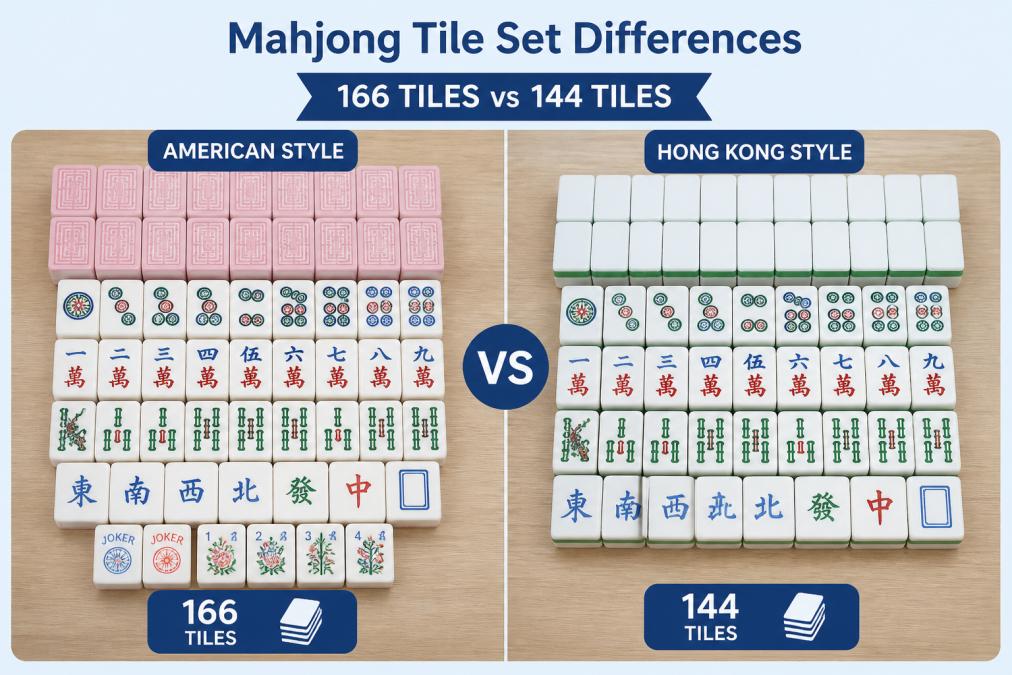
Jokers are the American set's signature addition. They act as wild tiles and can stand in for any tile needed to complete a hand on the card.
Flowers and seasons work similarly in both styles: they are bonus tiles that get set aside and replaced from the wall. Blanks exist in American sets as optional replacements or house-rule wildcards, and most groups leave them in the box.
If you want to see the extra tiles in person, browse our American Mahjong set in burgundy to compare the joker and flower count against a traditional set. Players who want a complete 166-tile set with all jokers and blanks included can shop the 166-tile American Mahjong set.

American tiles tend to run larger, with engraved and painted faces designed for readability across a table. Hong Kong sets often use slightly smaller tiles with denser engraving. Both are typically melamine these days, and both hold up to years of weekly play.
The American Mahjong card is a printed reference, roughly the size of a folded placemat, that lists every legal winning hand for the year. It is not optional equipment. Without the card, you cannot play American Mahjong, because the card defines what a win is.
Each year the card is reissued with new hand combinations. A hand that won last year may not exist on this year's card at all.
This is why American Mahjong feels more like a puzzle than a race. You are not building toward a generic pattern. You are building toward one of dozens of specific, printed targets.
If you are learning the card system, look at the International Mahjong Card for a card-sized reference.

Hong Kong style uses the classic meld vocabulary that most players recognize from traditional mahjong. A chow is three consecutive tiles in the same suit. A pung is three identical tiles.
Chows are the big practical difference. American Mahjong does not allow chows at all, so American players never learn to read sequences across a suit. Hong Kong players use chows constantly, which makes hands form faster and games move quicker.
Calling discards works the same way in both styles: you may claim a tile another player discards if it completes a meld, then expose that meld face up. To picture play at the table, a Mahjong Studios Clear Translucent Mahjong Rack And Pusher Set gives you the racks and pushers used during a game.
Hong Kong scoring is built on fan, a unit that measures how difficult a hand is. Each pattern in the hand carries a fan value, the values are added together, and the total fan determines the payment. Most groups set a minimum fan threshold, commonly 3 fan, so that trivial hands cannot win. Anything below the threshold is not a legal win and must be broken up.
Fan is not a single universal number. It is a schedule of pattern values that most groups agree on, and the schedule varies by table. A common pattern is:
These are representative values, not a rulebook. A group that plays weekly usually has a printed fan chart taped inside the lid of the tile case. Before your first hand, ask to see it. The chart is the scoring rule.
Payment follows the fan count. The winner collects from all three opponents, and the amount scales with fan.
There is also a discarder penalty. When you win on a tile another player discards, the discarder often pays the full amount and the other two players pay a smaller share, or the discarder pays double. This is the mechanism that discourages careless discards.
Suppose you win with a pure one suit hand: 1-2-3, 4-5-6, 7-8-9 of characters, a pung of 5 characters, and a pair of 9 characters. That is a pure straight plus a pung in the same suit, and most charts score it at 6 fan. If you drew the winning tile yourself, add 1 fan for a self-drawn win, for 7 fan total.
At a base payment of $1 per fan, the winner collects $7 from each of the three opponents, or $21 total. If the winning tile was discarded instead, the discarder might pay $14 and the other two players $3.50 each, depending on the table's discarder rule. The exact dollar amounts are house rules; the fan total is what drives them.
Take a hand of four pungs and a pair of East winds, all in mixed suits.
In Hong Kong style, that hand is a legal win if it clears the minimum.
In American Mahjong, that same hand only wins if it matches a printed combination on this year's card.
That contrast is the clearest way to understand the two games. Hong Kong rewards pattern recognition and fan counting. American rewards card reading.
Hong Kong style is easier to learn first. The rules are fewer, the melds are intuitive, and any four-sets-plus-a-pair hand can win.
American Mahjong has a steeper learning curve because of the card.
The tradeoff: once players know the card, many find American Mahjong more social. The card gives everyone a shared reference and slows the pace enough for conversation.
Moving from Hong Kong to American is the harder direction. You have to unlearn chows, learn the card, and accept that a perfectly good hand can be illegal.
Here is the checklist we would use:
Moving from American to Hong Kong is easier. You drop the card, add chows, and learn fan scoring.
One thing nobody tells you: the discard rhythm changes completely. Hong Kong players discard faster and read discards more aggressively, because every discard is a potential claim.
The rules matter, but the table matters too. A good set, a protected card, and a comfortable rack turn a confusing first game into a weekly habit. We curate mahjong pieces for players who host, and we think the setup is half the fun.
Our mahjong collection includes American sets with the full 166 tiles and beginner guides. If you are learning American Mahjong rules for the first time, our Quick Start Guide to Mahjong 101 - Oh My Mahjong covers the card notation and basic strategy in a format you can keep at the table.

Get started with Home 2 Court and build a mahjong table your group will want to return to.
You can use a Chinese set for American mahjong if it has 144 tiles plus enough jokers, but most traditional Chinese sets ship with zero jokers. American mahjong rules call for eight jokers, so you would need to add replacement tiles or use blanks as stand-ins. The 166-tile sets sold for American play include jokers, flowers, and blanks, which makes them the safer choice if you plan to play both styles.
No. Hong Kong Mahjong rules do not include jokers, and the standard set has 144 tiles with no blanks. American mahjong adds eight jokers and four blanks, bringing the total to 166. That single difference changes how hands are built: Hong Kong players rely on drawing and calling discards, while American players can substitute a joker for a needed tile, which speeds up hand completion.
Hong Kong Mahjong scoring uses fan, a multiplier system where each pattern in your hand adds value, and players agree on a minimum fan before the game starts. American mahjong rules score against the yearly card, where each hand carries a fixed point value and players compare totals. Hong Kong scoring rewards complex hands with higher multipliers, while American scoring keeps values consistent across the card.
Hong Kong Mahjong rules are easier to learn first because the goal is simple: build four melds and a pair. There is no card to memorize and no joker strategy to master. American mahjong rules add the yearly hand card, which requires reading and matching specific hands, and that learning curve is steeper. Many players start with Hong Kong style, then move to American once the tile suits feel familiar.

