

Last Updated: October 29, 2026
Quick Summary
To organize mahjong tiles efficiently, sort them in two passes: group by suit first, then order numbers low to high within each block. Stand tiles upright on the rack facing you, leave a finger-width gap between suit blocks, and keep one fixed suit order every hand.
Learning how to organize mahjong tiles efficiently starts long before the first tile is dealt. A clean, well-planned table makes every later step faster.
Mahjong tiles are the small rectangular playing pieces used in the classic game of skill and luck.
Here is the setup order that works:
The official rules overview from the National Mah Jongg League confirms that a consistent table layout keeps play fair for everyone.
A tidy hand is a fast hand. Sort your tiles the moment they land, and you will spend less time hunting during play.
Start by grouping tiles by suit. Set each suit in its own block on the rack.
Then order the numbered tiles within each block from low to high. This two-pass sort is faster than trying to do both at once.
Keep the face of each tile toward you and the blank back toward your opponents.
Middle tiles matter most. A small gap between suit blocks helps you see your hand at a glance.
Try this:
Gaps are not wasted space. They can act as visual markers that help you see your hand.
Stand your tiles upright and face them toward you. A straight, evenly spaced row on a narrow tray gives the best visibility of your whole hand.
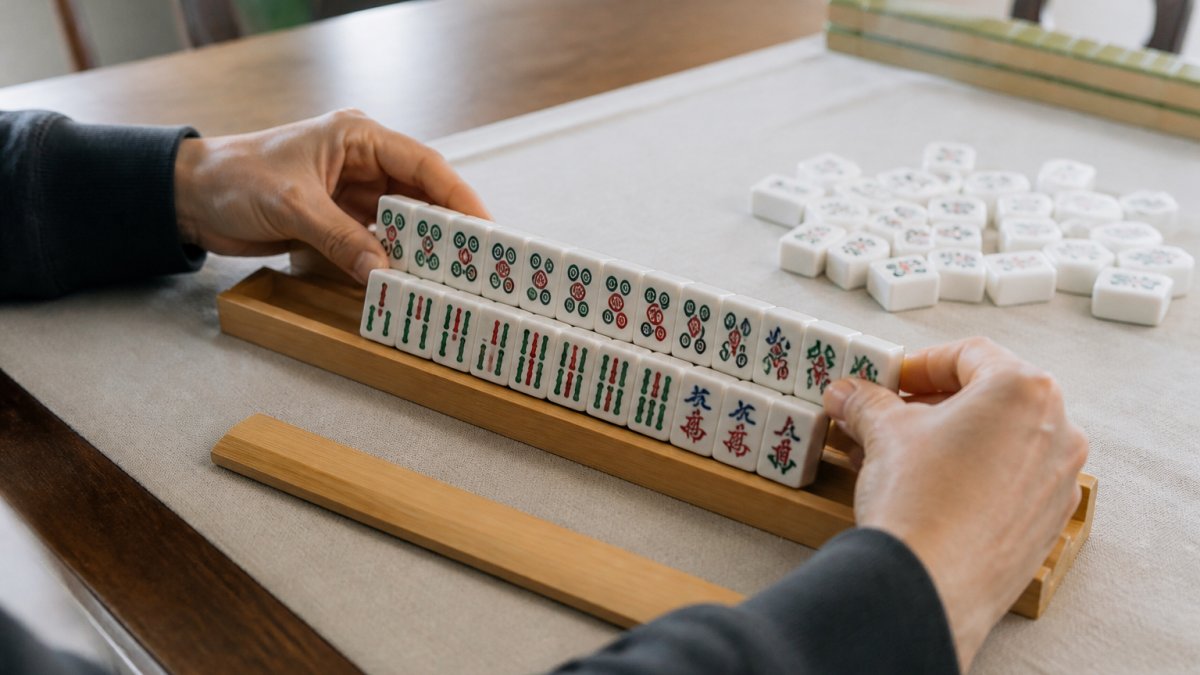
Many players settle into a fixed left-to-right order. A common pattern is:
Pick one order and keep it for every hand. The point is not which order you choose, it is that your eyes learn where to look.
Within each suit block, order numbered tiles low to high, left to right. Leave a small gap, roughly a finger-width, between suit blocks so your eye catches the boundary instantly. Do not leave gaps between individual numbers inside a run; those gaps slow scanning because your eye has to jump.
A practical rule: gaps mark suits, not tiles.
Tilt the rack slightly toward you rather than tilting individual tiles.
One honest limitation: clear racks show smudges, so a quick wipe before play keeps them looking sharp.
If you play with anyone who has low vision, arthritis, or limited grip strength, rack layout matters more than tile choice:
Build the wall in even rows, face down, and keep every stack the same height.
Work in this order:
Use the pusher flat against the wall, not at an angle. A Mahjong Multicolor Acrylic Rack Pusher Set gives you the racks and pushers needed to build walls and stay organized.
Watch out: building the wall too tall in one spot makes the deal uneven. Keep every stack at the same height.
Most guides treat sorting as one skill. It is not. A beginner, an intermediate player, and an experienced player are solving different problems at the rack, and the right workflow changes with experience.
Tile Storage Bag - Oh My Mahjong →
The real difference between a fast player and a slow one comes down to how few times they touch each tile. Every time you pick up a tile, look at it, and put it back down, you add seconds.
Sort with that in mind at every level.
New players should sort by suit only and skip fine number ordering at first. Speed comes later; accuracy comes first.
Beginners often over-sort. Rearranging the same tiles three times slows the whole table down and makes the hand feel harder than it is.
Once suit recognition is automatic, add number ordering inside each suit block.
This is the workflow most recreational players settle into, and it is the right one for casual weekly games.
Advanced players scan for completing a hand while they sort. They move tiles once and leave them. Instead of sorting first and planning second, they:
Sorting advice is not identical across variants, and this is where most guides stay silent:
Check your set's tile count and whether it includes jokers before you build a sorting habit around it. A workflow tuned for a 144-tile set will feel wrong on a 152-tile American set.
Store tiles flat, dry, and fully enclosed. Loose tiles in a drawer pick up scratches and dust, and missing pieces ruin a set.
Good storage options include:
A common mistake is stacking heavy items on top of a soft bag. Over time, that pressure can warp racks and scuff tiles.
Wipe tiles after every few games with a soft, barely damp cloth. Skip harsh cleaners, which can dull the printed faces.
Follow this routine:
Never soak tiles in water. Moisture can get under printed faces and cause peeling.
The U.S. Consumer Product Safety Commission offers general guidance on safe use of small game pieces around young children, which matters if little ones are in the house.
The biggest mistake is sorting tiles flat on the table instead of upright on the rack. Flat tiles hide your hand from you and slow every turn.
Here are the fixes for the mistakes we see most:
One more fix worth knowing: keep your rack at the same distance from the table edge every game.
The Library of Congress guide to games and puzzles notes that mahjong sets vary by region, so check your set's tile count before you build a storage plan around it.
Here are the fixes for the mistakes we see most.
| Problem | Fix |
|---|---|
| Tiles sliding together | Add small gaps between suits |
| Wall collapsing mid-deal | Keep stacks level and push straight |
| Losing track of turns | Keep the pusher aligned with the wall edge |
| Scratched tiles | Store in a lined bag, not loose in a box |
| Slow sorting | Sort by suit first, numbers second |
Before a game, place all mahjong tiles face down in the center of the table and shuffle them gently with your hands. Each player then builds a wall of stacked tiles, typically 17 or 18 stacks per side depending on the style. Keep the wall aligned and push it forward with a pusher so the playing area stays clear. Once the wall is built, deal the tiles and move straight into sorting your hand by suit and number.
Sort by suit first, then by number within each suit. Keep your rack in a consistent order every game so your eyes know where to look. Place middle tiles and pairs toward the center of your rack where they are easiest to reach, and leave small gaps between groups. This routine cuts the time you spend scanning your hand and helps you spot a completing tile faster.
Store tiles face down or stacked in a structured bag or case that holds its shape. A structured storage bag can help keep the set together and protect tiles from dust. Keep racks and pushers separated so they do not knock against each other. Store everything in a cool, dry place away from direct sunlight to prevent warping or fading over time.
There is no rule requiring a specific order on your rack, but a consistent arrangement helps you play faster. Most players sort by suit and then by number, keeping pairs and runs grouped together. Some styles and house rules may affect how you read your hand, so check the variation you play. The goal is efficiency and visibility, not a mandated sequence.
Organizing mahjong tiles well comes down to a few habits: a clean table, a two-pass sort, upright tiles on a clear rack, and storage that protects every piece. At Home 2 Court, we curate game-night pieces that make those habits easy, from clear acrylic racks and pushers to structured storage bags and carry-alls. Get started with Home 2 Court and turn a messy pile of tiles into a setup you can run in seconds.


