No Products in the Cart


Quick Summary
Good small apartment decor starts with the floor plan, not the furniture. Measure the room, map daily walkways and keep at least 30 to 36 inches clear for main paths, since blocked routes make rooms feel cramped.
Good small apartment decor works best when you start with the floor, not the furniture. Before you buy a single pillow, measure the room and map the paths people walk every day.
A simple paper floor plan saves money. Sketch the room on graph paper at 1/4 inch per foot, marking doors, windows, outlets and radiators, then test pieces on paper before you commit.
Record the length and width of each wall. Note where the door swings open, because a sofa that blocks the door will drive you crazy. Measure window sills and radiator heights too.
Here is a simple checklist to follow:
Watch out: Furniture often looks smaller in a showroom than in your living room. Tape each piece's footprint to the floor and leave it down for a day to feel how it affects traffic.
Clearances separate a room that photographs well from one that works every day. These minimums hold up in apartments:
These numbers are starting points, not code. If you cook a lot, give the kitchen path extra room; if you host often, protect the route between seating and the door.
Studio, roughly 400 to 500 square feet. Studios need zones.
One-bedroom, roughly 600 to 750 square feet. Place the sofa with its back toward the entry to divide the living area from the rest of the apartment, and leave the center open so the space reads as one flow.
Open-plan living and kitchen. Treat the boundary between cooking and sitting as a traffic lane.
Once the paper plan works, test it in the room. Outline each piece with painter's tape, then walk your daily routes: entry to kitchen, kitchen to sofa, sofa to bathroom. If you have to sidestep the tape, the real furniture will feel worse.
Watch out: A plan that works on paper can fail at the door. Measure the apartment entry, hallway turns and elevator opening before you order anything wider than 36 inches, and check that the piece can be stood on end if the hallway is narrow.
Every piece in a small apartment should earn its place. A good rule is that each item does at least two jobs.
Look for pieces that fold, stack or nest. Nesting tables give you extra surfaces when you host and tuck away when you do not.
Tall, narrow furniture helps too, and it is one of the smartest moves in small apartment decor.
Here is a quick comparison of common space-saving options:
| Furniture Type | Main Benefit | Best For |
|---|---|---|
| Storage ottoman | Seating plus hidden storage | Living rooms |
| Drop-leaf table | Flat when closed, full-size when open | Dining nooks |
| Murphy-style bed | Frees floor space by day | Studios |
| Nesting tables | Extra surfaces that tuck away | Small living rooms |
Clutter is the fastest way to make a small apartment feel tight.
Start with vertical space. Wall-mounted shelves, tall cabinets and hooks by the door move items off the floor.
Closed storage also keeps visual clutter down.
A common mistake is buying storage bins before you edit your belongings. Sort, donate and toss first. Then choose containers that match the space you actually have.
A small living room feels bigger when the seating does not crowd the middle. Compare mindful, minimal layouts with traditional room designs on Mindful Living Spaces Vs Traditional Home Design.
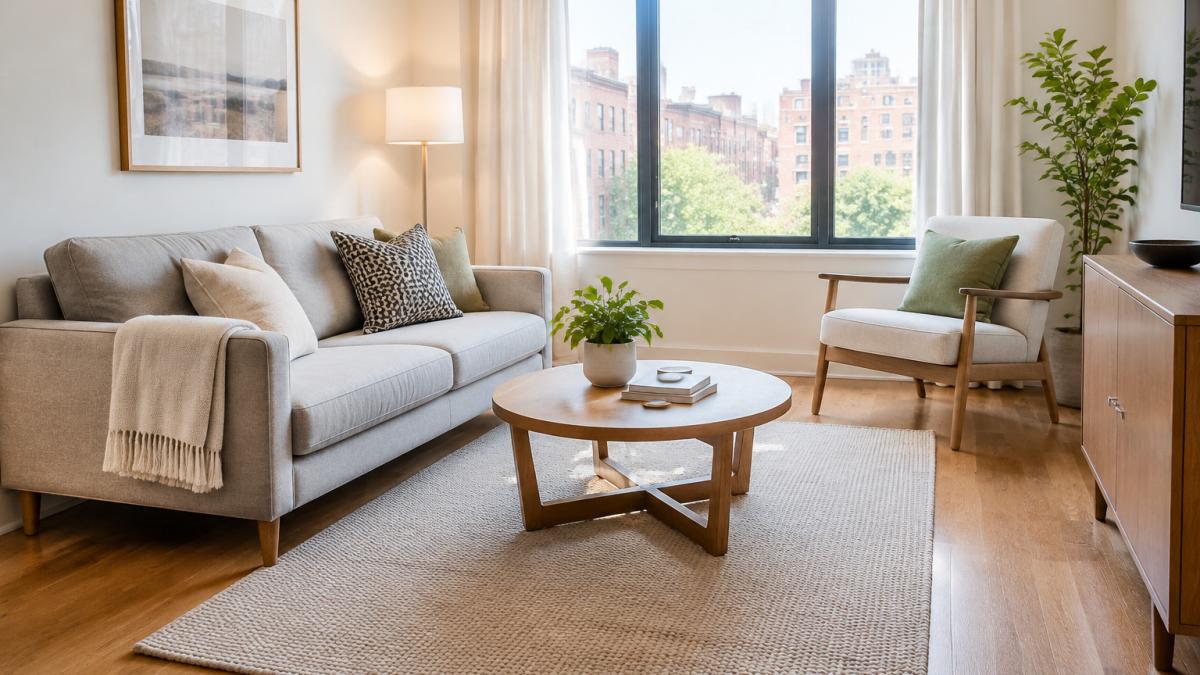
Light colors help too, since pale tones are a staple of small apartment decor that feels airy.
Mirrors can open up a wall. Hang one across from a window so it bounces daylight into the room.
Layered lighting matters as much as color. Use a ceiling fixture for general light, a floor lamp for reading and a table lamp for mood.
Budget small apartment decor works when you spend on the pieces people touch and see most: a solid sofa cushion, a good rug and quality bedding. Save on accessories, which are easy to swap later.
Thrift stores, estate sales and secondhand marketplaces often carry solid wood furniture at fair prices. Paint and new hardware can transform an old dresser.
Here is where to spend and where to save:
Our pick for a budget-friendly lighting upgrade is the Bobbin LED Sage lamp from Home 2 Court, priced at $172.00. It offers up to 10 hours of battery life on its brightest setting, three adjustable light levels, and can be used as a portable or stationary lighting feature.
Rental small apartment decor is about reversible changes. Command hooks, tension rods and freestanding furniture let you personalize a space without drilling holes in the walls. Check your lease before you paint or change fixtures, and get written permission for anything that alters the unit.
Most leases spell out what you can and cannot change. Look for clauses on painting, wall anchors, shelf installation, wallpaper, and permanent fixtures such as ceiling lights or showerheads. Small nail holes for pictures are often allowed, but larger anchors, shelves or painted walls may require approval or a restoration fee. If the lease is silent, ask the landlord in writing and keep the reply; a short email confirming removable wallpaper is fine can save a deposit dispute later.
Match the method to the wall and the weight. These are the workhorses renters rely on:
Watch out: Adhesive products can pull paint or leave residue on poorly bonded walls. Test one strip in a hidden corner, leave it for a week, and remove it before committing to a whole wall.
Battery-powered lamps are a smart rental choice. You get warm light without rewiring anything or relying on a single overhead fixture. Look for a model with a stated run time per charge, a dimmer or multiple brightness levels, and a charger you can move between rooms. Place one on a shelf, a windowsill or a side table where a cord would otherwise cross a walkway.
Take dated photos of every room when you move in, including floors, walls, appliances and any existing damage, and store them in the cloud. Keep a small bag of patching supplies: spackle, a putty knife, fine sandpaper, a touch-up paint sample matched to the wall, and removal tabs for your adhesive hooks. A quick touch-up before move-out is often cheaper than a deposit deduction.
Watch out: Do not patch or paint a large area yourself unless you can match the existing finish. A visible patch can cost more than the original damage; ask the landlord which approach they prefer.
Pick the room that bothers you most and start there. Measure it, sketch the floor plan and clear the walkways. Then add one multifunctional piece and one storage solution before you buy anything else.
Small changes add up fast. Once one room feels open and easy to use, the rest of the apartment follows. Home 2 Court carries decor, lighting and gifts chosen to fit compact living, so you can build the look you want one piece at a time.
Start with a consistent palette of two or three colors and keep most surfaces in light, neutral tones. Choose furniture with visible legs so floor space shows through, since open floor makes a room read as larger and more deliberate. Add a few well-chosen accents such as a textured throw, a lamp with warm light and one large piece of art. Limit decor to a small number of items per surface so each piece has room to be seen. Styling works when the pieces look chosen rather than accumulated.
Use mirrors opposite a window so they reflect daylight deeper into the room. Hang curtains close to the ceiling and wider than the window frame to make walls look taller and the window look larger. Keep lighter colors on the walls and larger furniture, and avoid wall-to-wall rugs that cut the floor into small pieces. Keep traffic paths at least 30 inches wide so the room feels easy to move through, and leave clear space around the sofa and bed.
Use tension rods for curtains, adhesive hooks rated for the weight you plan to hang, and freestanding furniture instead of built-ins. Plug-in wall sconces and battery or plug-in lamps avoid wiring work. Area rugs and removable wallpaper or peel-and-stick tiles can change a room without damaging paint. Before you start, photograph the space and check your lease for rules on painting or hanging items, so you can restore everything at move-out.
Spend on the few items you touch and see most, such as a good mattress, a sofa with a solid frame and reliable lighting, and save on decorative pieces. Shop secondhand for furniture and frames, and repaint a dated dresser or cabinet instead of replacing it. Buy one or two accent pieces at a higher price point, like a lamp or a vase, and fill the rest of the room with simpler items that share its color and material. Plan your purchases on a list so you buy only what fills a defined gap in the layout.

